
If you’re looking to elevate your SQL Server expertise, mastering the TSQL Output Clause is a game-changer. This often-underutilized feature allows you to capture and return data from INSERT, UPDATE, and DELETE operations, opening up new possibilities for auditing and change tracking. Whether you’re a database administrator or a developer, understanding how to harness this tool can streamline your workflows and improve data integrity.
Imagine being able to track every modification in your database with precision or even create mechanisms to undo changes effortlessly. The Output Clause empowers you to do just that by providing a window into the data affected by your DML statements. It’s not just about retrieving results—it’s about gaining deeper control over your data management processes and ensuring accountability in your systems.
In this blog post, we’ll dive into the practical applications of the TSQL Output Clause, exploring how it can be used to enhance your SQL Server skills. From setting up effective audit trails to implementing change tracking, you’ll discover actionable insights to apply in real-world scenarios. Let’s unlock the potential of this powerful feature and take your database management to the next level.
Using the TSQL Output Clause
The SQL Server Output Clause is a powerful feature for retrieving data from INSERT, UPDATE, or DELETE statements. This class will show you how to leverage the Output Clause for auditing, tracking changes, and creating an undo mechanism. An often overlooked feature, it can significantly enhance your ability to write effective queries.
Watch this video by Steve Stedman to find out more.
For additional informative videos, visit my YouTube channel at https://www.youtube.com/@SteveStedman. There, you’ll find a wide range of content covering various topics, all designed to provide valuable insights and help you stay informed.
Course Highlights:
- Learn how to use the Output Clause in your INSERT, UPDATE, and DELETE statements.
- Understand practical applications for auditing and change tracking.
- Gain insights into capturing changes for undo operations.
What Students Are Saying:
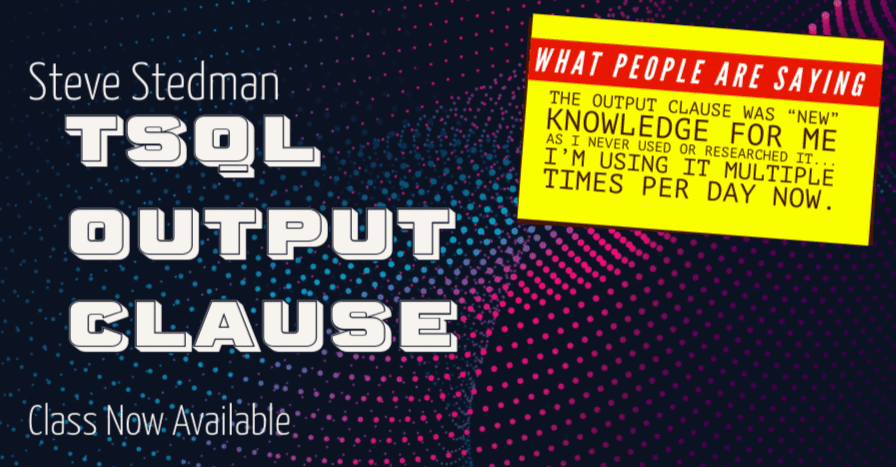
“The Output Clause was ‘new’ knowledge for me. I never used or researched it before, but now I use it multiple times per day.”
— George (Course Student)
“I watched the whole course. Really great lesson.”
— Mo
Enroll Now:
This focused course is part of our SQL Short Courses series, designed to be highly targeted and value-priced. Completing this course will earn you a certificate to display your new skills proudly.
What You Are Getting:
- Detailed lessons on using the Output Clause.
- Practical examples and homework to reinforce learning.
- A certificate of completion to showcase your achievement.
Prerequisites:
- Basic knowledge of SELECT, UPDATE, and DELETE statements.
- Access to a SQL Server environment for hands-on practice (helpful but not required).
Course Lessons:
- Introduction
- Output Clause Course Introduction (3:00)
- Output Clause Overview
- Sample Code
- Output with Insert Statements
- Output with Insert Statements (12:42)
- Homework for Insert Statements
- Output with Update Statements
- Output with Update Statements (7:54)
- Homework for Update Statements
- Output with Delete Statements
- Output with Delete Statements (4:58)
- Homework for Delete Statements
- Archiving: Delete with Output
- Archiving: Delete with Output (8:46)
- Review – Wrap Up
- Review (4:08)
- Output Clause Summary
- Course Completion Certificate
- Course Completion Certificate (1:23)

For more details and to enroll, visit: Using the TSQL Output Clause
Join the class and start enhancing your SQL Server skills today!
Other Classes and Related links
- Stedman SQL School
- Database Health Monitor Class
- Backup and Recovery Class – (Overview Video)
- JOIN Types class
- SQL DBA and Developer Interview Prep Course
- Corruption Repair Course – (Overview Video)
- SQL Server Performance Tuning class
- Youtube video with a overview of all our classes.
- Mentoring from Stedman Solutions.
- Need help, reach out for a free 30 minute consultation.