
July is Database Health Monitor Month!
July has arrived, and it’s time to turn our attention to the heartbeat of our digital world – our databases! As the founder of Database Health and Stedman Solutions, I’m thrilled to proclaim this month as Database Health Monitor Month! This is our annual chance to celebrate the unsung heroes safeguarding our precious data and to explore the intricate web of data structures and relationships within our systems. Let’s take a closer look at their health, uncover hidden issues, boost performance, and ensure our data highways are running seamlessly. This July, let’s commit to not just keeping our databases operational, but ensuring they thrive at peak performance!
This month also marks the anniversary of Database Health Monitor. To celebrate, I’m excited to offer 25% off the licensing fee for the annual subscription to Database Health Monitor. Don’t miss this opportunity to enhance your database management!
Exploring the Table Use Report in Database Health Monitor
Databases are critical to any organization, powering applications and storing essential data. But do you know which tables are actively used and which are dormant, consuming unnecessary resources? The Table Use Report in Database Health Monitor provides valuable insights into SQL Server table usage, helping administrators optimize performance, manage storage, and enhance security. In this blog post, we’ll dive into how the report works, what it reveals, and how it can benefit your database management.
What is the Table Use Report?
The Table Use Report tracks the last accessed time for each table in your SQL Server database. By showing when tables were last queried, it enables database administrators to identify frequently used tables, detect unused ones, and make informed decisions to improve database efficiency. Whether you’re fine-tuning performance, cleaning up storage, or auditing security, this report is an essential tool.
Understanding the Report
The Table Use Report is organized into two clear sections for easy analysis:
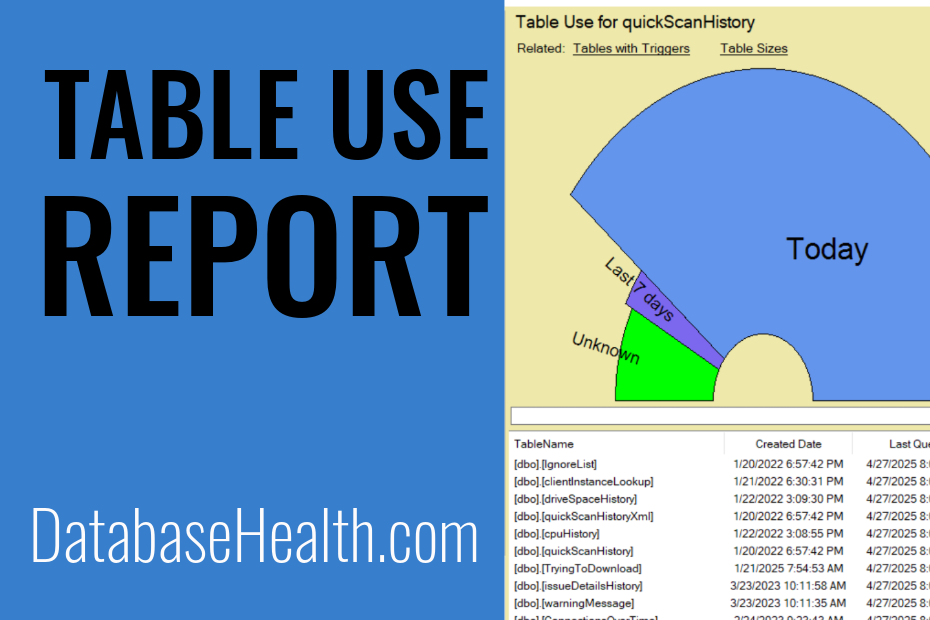
Graphical Representation
The report begins with a fan chart that categorizes tables based on their last usage:
- Today (Blue) – Tables queried today.
- Last 7 Days (Purple) – Tables accessed within the last week.
- Unknown (Green) – Tables with no recorded query activity.
Detailed Table View
The second section is a grid that provides specific details for each table, including:
- Table Name – The name of the database table.
- Created Date – When the table was created.
- Last Queried – The last time the table was accessed.
- Range Used – The category indicating how recently the table was used (e.g., “Today”, “Last 7 days”, “Unknown”).
Use Cases for the Table Use Report
The insights from the Table Use Report can be applied in several ways:
- Performance Tuning: Identify frequently accessed tables to prioritize for indexing or partitioning.
- Database Cleanup: Detect unused tables that could be archived or deleted to free up space.
- Security Auditing: Verify that critical tables are actively used and spot any unusual activity.
- Storage Optimization: Reduce database size by compressing or removing rarely accessed data.
How to Interpret the Report
The report’s categories help you quickly assess table activity:
- Today: Tables marked as “Today” are actively in use.
- Yesterday: Tables accessed yesterday but not today.
- Last 7 Days: Tables used within the last week but before yesterday.
- Unknown: Tables with no recorded activity, which may be obsolete or unused. These warrant further investigation.
Note that SQL Server only tracks table usage since the last restart. If your server was recently rebooted or restarted, more tables may appear in the “Unknown” category.
Why Use the Table Use Report?
The Table Use Report in Database Health Monitor transforms raw data into actionable insights. By highlighting which tables are driving your database’s workload and which are idle, it empowers you to optimize resources, enhance performance, and maintain a lean, secure database environment. Whether you’re a seasoned DBA or new to database management, this report simplifies the process of keeping your SQL Server in top shape.
Get Started with Database Health Monitor
Ready to unlock the power of the Table Use Report? Download Database Health Monitor today and start exploring your database’s activity. With its user-friendly interface and robust reporting, it’s the perfect tool to ensure your databases run smoothly and efficiently.
Check out this offer:Explore our Database Health Monitor special pricing.

Here are all the discounts for Database Health Monitor. Pick the one that fits your server count.
25% off 1 Instance – Code: 25OFF1
25% off 10 Instances – Code: JULY25
25% off 20 Instances – Code: 25OFF20 – Best Value
Free Backup and Restore Course when You Purchase Database Health Monitor
Purchase a new one-year Database Health Monitor subscription during the fourth week of July and receive our SQL Server Backup and Restore Course free of charge. Backups are your last line of defense when disaster strikes, but many organizations don’t discover problems until they need to perform a restore. This course walks through backup strategies, recovery models, restore techniques, and best practices to help ensure your data is protected and recoverable when it matters most. Pairing strong backup practices with the monitoring capabilities of Database Health Monitor gives you greater confidence in the health and resilience of your SQL Server environment. A $39.99 value included free with your purchase.
Check out this offer:Explore our Database Health Monitor special pricing.
Here are all the discounts for Database Health Monitor. Pick the one that fits your server count.
25% off 1 Instance – Code: 25OFF1
25% off 10 Instances – Code: JULY25
25% off 20 Instances – Code: 25OFF20 – Best Value
Free Backup and Restore Course when You Purchase Database Health Monitor
Purchase a new one-year Database Health Monitor subscription during the fourth week of July and receive our SQL Server Backup and Restore Course free of charge. Backups are your last line of defense when disaster strikes, but many organizations don’t discover problems until they need to perform a restore. This course walks through backup strategies, recovery models, restore techniques, and best practices to help ensure your data is protected and recoverable when it matters most. Pairing strong backup practices with the monitoring capabilities of Database Health Monitor gives you greater confidence in the health and resilience of your SQL Server environment. A $39.99 value included free with your purchase.