
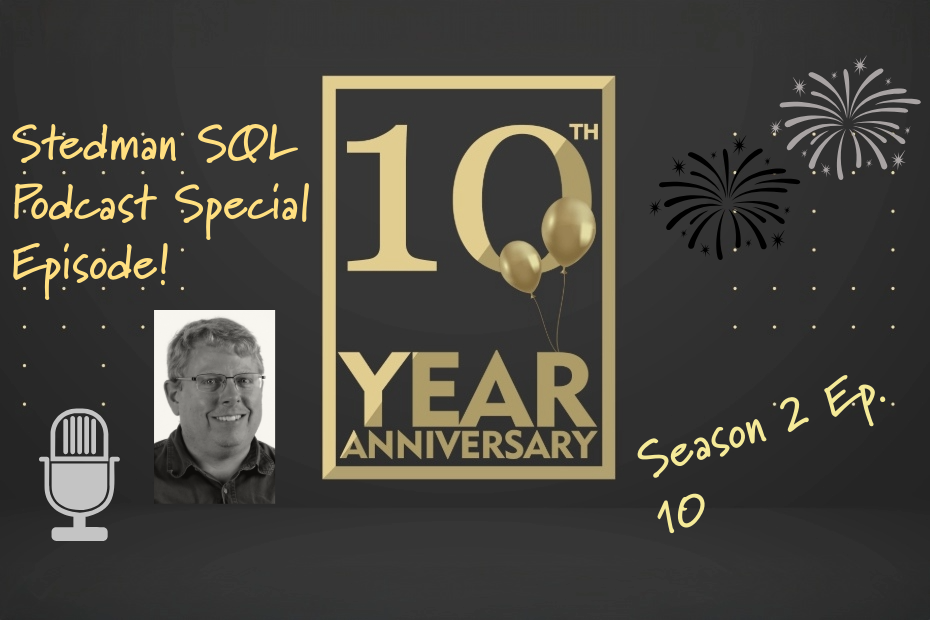
- Host: Steve Stedman / Shannon Lindsay
- Topic: 10 Year Anniversary of Stedman Solutions
- Recording Date: February 26, 2025
- Helpful Links: Stedman.us/PodcastYoutube Stedman.us/PodcastSpotify Stedman.us/Performance-class
Stedman SQL Podcast Season 2 Episode 10 Stedman Solutions 10 Year Anniversary
Happy 10 Year Anniversary to Stedman Solutions! In this special Stedman SQL Podcast episode, Steve reminisces back on the last decade of how Stedman Solutions came to be, the learning curves and growth that the company has had, and announces an exclusive gift for our listeners. Thank you for the last 10 years, and here is to the next!
Podcast Transcript
Steve Stedman 00:15
Welcome everyone to this week’s episode of The Stedman SQL Server podcast. We are in season two. This is episode number 10, and I’m your host, Steve Stedman, and today, Shannon Lindsay joins me as my co host. Welcome Shannon. If you’ve missed last week’s episode, please check out Season Two, Episode Nine, where Mitchell and I discussed the new February 2025, features in Database Health Monitor, including the deadlock monitor and email alerting enhancements. And welcome everyone to this podcast. And this podcast is a special one for me. 10 years since starting Stedman solutions. Now they say the diamonds are the best 10 year anniversary gift, but it’s not that kind of an anniversary. And I’m not giving away any diamonds today, but I am going to give away for free to the first five people who email [email protected] and ask her for access, free access to the SQL server performance tuning course for our 10 year anniversary gift. So that’s a $200 value that five people are going to get absolutely free. And then the next 25 people after that, who email Shannon will get 50% off. So that’s $100 savings for that next batch there on our SQL server performance tuning, course, just as an anniversary gift. So if you visit Stedman.us/performance-class, you can see what that class is. And if you’re lucky enough to be one of the first five or the next 25 you need to get it for free or with a 50% discount. So on to the episode 10 years at Stedman solutions. Wow.
Shannon Lindsay 02:02
Congratulations. That’s exciting.
Steve Stedman 02:04
Yeah, I’ve never had a job for 10 years prior to this. I mean, I think seven or eight years, as long as I ever went before starting with solutions. So I guess this was an interesting startup for me, in that my wife, Marcia, was in nursing school and about halfway done with that, that was sort of a mid career change for her to start something brand new. And we planned that once she completed nursing school and got her first job in nursing that I would quit my day job at that point and start Stedman solutions full time Well, as with all great plans things change and on March 31 of 2015 with Marcia, about halfway through nursing school, I lost my job, so March 31 and April 1, 2015 Stedman solutions began. It was, yeah, it was an interesting time. I was kind of excited that I’ve been planning for it, but not excited to lose my job the way I did. So I’m okay with that now looking back.
Shannon Lindsay 03:08
And it’s, it is kind of funny, too. Your number one advice is never announce a new business on April Fool’s Day.
Steve Stedman 03:18
Yeah, so to get started on like March 31 and April 1. I’m scrambling to get a website together, and I get something done real quickly, and then I put it out on LinkedIn and Facebook and places like that, saying, Hey, new business just starting. I’m now full time at Stedman solutions. I have no other no other job getting in the way of starting this. And a lot of people thought it was an April Fool’s joke. So if that ever happens to you, on with that kind of timing, wait a day or two after April Fool’s Day and maybe get a little bit more traction on that initial announcement.
Shannon Lindsay 03:51
Yeah, well, and then each year, each year afterwards too. And you’re like, hey, we’ve hit our five year, we’ve hit our 10 year. And it’s like, don’t I’m not kidding.
Steve Stedman 04:04
Yep. So 10 years, even though it’s about April Fool’s Day, when we’re putting this episode out, yeah, it’s not a, it’s not an April Fool’s joke, it’s real. So now getting beyond the whole April Fool’s thing, I mean, this was one of those things that, as soon as I put out that I was available, a couple people took it seriously, and within eight hours of initially announcing that I had a verbal agreement with my first client, the problem was, though, it took three weeks to get a contract signed, and then once I started working with them, another four weeks to get that first payment. So starting out, I gave unemployment, Washington state unemployment my first, first try, and quickly learned that, oh, that was not something that I wanted to be part of. And part of the problem was that I’m trying to build my business and start it out, but unemployment wants you to go to all these classes and how to be a good. Employee and how to fill out resumes and stuff like that. But I didn’t want to have anything to do with that, because I wanted to grow my business and not just go apply for a job somewhere else. So I quickly gave up on that, and on unemployment at least, and kept growing the business. And that was April, when we started. By mid September, I had more than 40 hours available work per week ongoing, which was more work, more time, more revenue than I had for my previous job. And things were going good at that point. And in this in that first year, 2015, also in that time between April and September, when I got really busy, I had more free time, I was able to evolve the website, and, oh, we’ve got a couple screenshots so, but the original website, and then we went on and I built the database corruption challenge right after starting the company. And that was something that I did kind of as a fun little project, and it turned out that it helped get the word out there about our SQL skills and our ability to go well our I say our is mine.
So just me at that point in time, my ability to go and work on corrupt databases and to fix corrupt databases and to work on a lot of kind of heavy lifting DBA type skills, and that was a blast. I met a lot of really interesting people with that, and it got the word out, and we started working on doing some database corruption repairs along the way. So then, after that first year, jumping into 2016 2017 2018 I just kind of kept on pushing through with the business. I got active in Pass, which was the professional association for SQL Server, which at that point in time, was this independent organization that was just putting together conferences around SQL Server. And in 2016 I did a presentation on database corruption. 2017 I had two sessions at that conference. And this is a conference with, like, four to 567, 1000 people, something like that. I don’t know exactly how many, but more around 5000 people, maybe. And the corruption repair session, I did that second time there was at the end of the day on Friday, and the room was completely packed on that one, which is really intimidating when you’re going into a presentation and the room’s packed, it’s hot, everybody’s there to listen and but we had a great time, and that helped get the word out about a lot of stuff we do with production, repair and our DBA services. And then in 2018 I did a joint types presentation at Pass Summit, and those were all big conferences in Seattle, but it was one of those things that as business was getting busier, I got to the point that taking a whole week to go to a conference was too big of a distraction, because I had a lot of clients that I couldn’t just put on hold for a whole week, and in all of that work I did at those presentations at past Summit, never once did I ever get a business lead from that. I got the word out there a lot, but I could never once attribute a paying clients anything I ever did at pass Summit. So I decided at that point well pass summit wasn’t for me, and if I’m going to take a week away from my clients, I’d rather be in Hawaii or somewhere else, in a tropical beach than in Seattle at some conference. So it was a lot of fun, but I just had to, because of the how busy things were getting, I had to reprioritize in there as well. Now, in that same time, in the 2016 through 2018 I had my first podcasting experience where I worked on the SQL Data Partners Podcast as a co host, and I built a business relationship there and but after about a year to two years of working in that, I guess it was closer to two years working with different clients, with them turned out not to be what I was looking for. I really loved the podcast work, but the whole business relationship that was that we’re going into there was not really my style, and it evolved into something where we used my skills to help land the client, and then kind of after that, hand them off to cheap, unskilled, offshore labor. And that was not what I wanted to be part of. If I’m going to have my name on it, I want to be associated with getting good work done, not handing it off to some cheap labor somewhere. So that ended didn’t end very smoothly, that SQL Data Partners relationship, but it was okay. And along this time, also a friend of mine that I met through the database corruption challenge. Randolph West, he joined me for a bit on some contracting projects as a as a subcontractor, and for a couple of years in there, he helped me out great deal with a couple of clients. And even today, I help him with a few things once in a while. So it’s building those relationships with people that you. Can trust and work with, and Randolph was one of those that turned into a really good thing there. Yeah.
Shannon Lindsay 10:05
When would you say that you hired on your first full time employee, or just your first employee?
Steve Stedman 10:13
The first employee was in 2018 and that was Derrick Bovenkamp. And Derrick’s a friend, and he and I were having lunch, and I was just talking about how busy, how crazy busy the business was. And he’s full time employed somewhere else, and he offered his time. He said, well, what if I work part time with you on some of the projects I can help after hours and weekends and things like that, and Derrick joined the team, and it was a huge, huge help. At that point. He helped me with a few corruption repairs that year, as well as several SQL server performance assessments. And adding his skills to my skills really helped strengthen the company. So that was April of 2018, and by the way, Derrick still with us and working regularly on projects, and then in September, we added Bill Simpkins. Bill was someone that I had worked with one of the earlier clients, and that client had had some structuring chaos through mergers and layoffs and all that kind of stuff. And Bill was available, so Bill joined the team, and Bill brings some architect level programming and performance tuning experience, and he’s great asset. So the two of them joined in 2018 and at that point, we were doing a lot of hourly billing type projects, which we still do occasionally, but we started to kind of focus more on monthly service customers, although we didn’t call it managed services yet, which is what we do a lot of today. But we were on kind of a monthly retainer, starting to work with more clients, where we were just taking care of all of their systems and making sure that everything was good and handling all their services, and that’s what eventually merchant or run into managed services. However, during that time, we worked on a lot of like hourly and project based projects that helped grow our skills but also helped grow the customer base there too.
Shannon Lindsay 12:20
So this is 2018 what would you say 2019 kind of brought for you?
Steve Stedman 12:30
Well, 2019 Derrick and Bill were still working with me, and we continue to grow. And had clients that we were regularly working with there. During that time, we worked with an evolved Database Health Monitor, and I kind of realized at that point now that they were helping me, that freed me up a little bit more to put a little bit more time in a Database Health Monitor. And then we did a few more corruption repairs and a few more performance assessments throughout that time frame as well. And then we got into 2020, and 2020, was the disruption of the entire universe. Well, at least our entire planet with this, with the start of COVID. And we, we were doing really well. And I had a slogan we were working with. Well, no, the slogan came out later, but that we were working remote before COVID made it popular, and I think that it helped legitimize some of the stuff that we were doing, working remotely for lots of different clients. But part of what happened at that time is I hired my first assistant, and the person I hired for that role was with me for a couple years, but didn’t work out, and I was trying to figure out, well, how can I get some help with a lot of these business stuff related things that I’m doing on a daily basis? And the first person I tried for that didn’t work out. And then fortunately, Shannon came along later helped me with those things two years later.
Steve Stedman 13:58
Yep, but at that point, I started Stedman SQL School. And in July of 2021, we had our first class where, and those classes are still available today, and September 2 and third class. In October, we got to use a Database Health Monitor class out, and then onto a ransomware class and backup class. And with that, oh, and we even gave away the ransomware class for free, and that’s still free today, because I really hate those people that are putting out ransomware. And anything we can do to prevent ransomware, I want to make it available for free so that one’s still available for free. If you go to Google on Stedman SQL school, or go to Stedman.us/school, for the short URL, and get there, you can see all those classes, but that was really my first, I don’t know, kind of diving into more of a recurring revenue stream from building things like that, rather than just trading time for money at that point. Yeah, this was more of an investment for the long term.
Shannon Lindsay 15:01
Yeah, what gave you the idea for the SQL school?
Steve Stedman 15:05
Well, I think there were a lot of things that I had done with past summit in the past, and then we’d also working with SQL Saturday events, which were, was a free conference you can go to in different areas on Saturdays, and teaching and sharing and presenting, and there was a lot of stuff that I’d done there, from corruption repair to the joint types class and things like that that I thought these are things I want to share more of, but because we’re in COVID and things are locked down, nobody’s going out and doing those anymore. So how about if I put them together an online platform that, for a small fee you can pay and get access to the class sort of justify the time I invested in it. Yeah, and then during that time, I don’t know exactly when it was somewhere late, 2020 early. 2021 we started to introduce what we started formally calling managed services at that point, and that was our monthly all inclusive B to take care of your SQL servers. Now, prior to that, we had a couple people that we were doing that with, but we just didn’t work calling it managed services, and we kind of refined the offering there, and that’s where we looked at things like, Well, if you get database corruption as a managed service customer, we’re not going to charge you anything extra to fix that. If you’re following our backup and restore procedures and our check DB recommendations, because we know we can get you quickly recovered in those situations, we added things like all of our Stedman SQL school classes are free for our managed service customers, free, included Database Health Monitor included for all of our managed service customers. Basically, it is truly a one fee for everything to take care of those SQL Servers there. And there’s some months that it feels like we’re doing well, and other months it feels like, Oh, gee, that customer got hit with something bad, and we spent 100 hours between two or three of us rebuilding a bunch of SQL servers because they got hit with ransomware or different things like that. Well, that’s just how it works out with managed services, we’re there to take care of the clients when they need it, and it’s been really good working on the Managed Services. I’m happy with what we’re doing with those today.
Shannon Lindsay 17:11
So that, I mean that kind of was 2020, 20 and 2021, where did 22 and 23 kind of lead you?
Steve Stedman 17:23
Well, at that point, we had more growth. And I think back to when I first met with Derrick at lunch. I He came and helped me out, and then I met Bill, and Bill joined in the team, and I was at the point where we were getting more and more work, and I was just getting more and more overloaded. I didn’t even have time to take vacation, and so we brought more people onto the team. At that point, Laura joined the team, Eric joined the team, and the two of them have focused mostly on managed service customers since they joined. Alex, our bookkeeper, joined He’s helped me immensely with things like tax and preparation, with billing and invoicing and all those kind of things, and making sure that we’re doing all the right stuff with the government so we don’t get stuck in an audit or those kind of things, you know. And then we were taking on. We, at that point, we did have a lot of hourly work coming on. And I think Eric was involved in a lot of the hourly work, and then we’re attempting to move more to the managed services. Because the problem with the hourly work was that it really varies on a month to month basis, where managed services gives you more of a solid base, growing month to month that you can plan around a little bit better. I mean, there were months where we might have, I don’t know, several 100 hours of billable work on hourly work, and then the next month, the would finish the project, and we’d be trying to find that next hourly work. Whereas with managed services, it gives us more of that solid month to month, as well as giving the clients a more stable, reliable environment that they can work with. And again, during that time, as well, I added more classes into Stedman SQL school by bringing these extra people on. That freed up a little bit more of my time in order to be able to add more classes there and grow our Stedman SQL school offering. Then 2024, I think. What was it? Early 2024, Shannon, you joined the team.
Shannon Lindsay 19:25
Exactly a year ago today.
Steve Stedman 19:29
Oh, exactly a year ago today is the deal. We’re recording this, not today. It’s going live. Yeah. And I thank you for joining. You’ve helped make my life easier and help give me more time to focus on those things that are important to the business. And like I said, we hired the wrong assistant initially, and eventually we got the right one, and that’s you. So then George. George is my son. He graduated Community College with a BS in cyber security. And Mitchell, who’s a friend of his as well, graduated, and the two of them are the young guys on the team they joined. And George is part time, and Mitchell is full time, and he’s the first full time Database Health Monitor developer that we have. So currently, he’s been well, he started out part time as an intern, actually Mitchell did, but then he eventually, when he graduated, moved into full time as Database Health Monitor developer. And then George works with some of our hourly customers, some of our managed services, and then with Database Health Monitor when he has available time.
But in 2024 we wanted to grow. We wanted to do more, and that’s where we tried things and failed. So I hired a director of sales and marketing, and to be honest, I don’t know how to manage the Director of Sales and Marketing. I’ve never done that, but we brought someone in. We worked with him for about six months, and after six months, I just had to give up on it. Basically, his way of doing things didn’t really fit in with our culture overall. And one of the things that’s really important to me is our culture and making sure that what we’re offering is solid and not I mean, it’s something that we never compromise on integrity and things like that. And I think that a lot of the marketing strategies that we’re trying to do there turned out to be a little bit spammy, and I didn’t really want to be part of that at all, so that just didn’t work out. But that’s okay. We’re still here. We’re still growing. And then the other thing in 2024 I’ve been doing a lot of streaming ever since I started the company. But we formalized what we’ve been doing with streaming into our Stedman Solution SQL podcast that you’re watching right now. And we had season one, I think, what did we have? About 12 episodes in season one of 2024 and yeah, it’s been going well. Shannon’s been helping me a ton with that as the co host and editor. And that brings us into 2025 our 10 year anniversary, we’ve been able to make it to 2025 the company has zero debt, which gives us a lot more stability to not have to be paying debt service every month to someone. We’ve transitioned the business into more of a recurring revenue stream over the last four or five years with managed services, database, health, monitor licensing and SQL Server classes are in our income has increased every year since I started the company, except for one year during COVID, it was slightly lower, but we made up for that the next year. And our managed services revenue has been increasing every year. And managed services is now responsible for about 66% of our overall, overall revenue for the whole company, which is, is great. I mean, we plan to do more, more with that going forward, but I’ve been really happy with what we’ve done, done to get there. And like, like I said earlier, we had a slogan around working remotely before COVID made it popular. And what that really meant to me, because when we started out the company, the first few clients I was working with were local to Whatcom County, where we live, and I was running around, and it seemed like I was in the car for several hours every day, going from client to client, and sitting down in different places and working with them, and then running to a different client. And I spent a whole lot of time in the car, and that was a whole lot of non buildable time sitting in the car. So by working remotely, that meant that I could focus a lot more time on our customers and less time actually sitting in the car in traffic.
Shannon Lindsay 23:49
Yeah, it’s almost easier for them, too, because to try to schedule a meetup versus just a meeting is huge time difference.
Steve Stedman 24:01
And with that, yeah, that worked out to be great benefit for the customers, because, I mean, we do really detailed time keeping and that allowed me that if something came up, I could shift during the day. Instead of saying, Well, I’m on site with the client, I’ll be able to get to that in four hours. I could just clock out on one client, clock in on the other, deal with something urgent, and when that was done, eventually go back to work for that first client I was working with. And with the exception of scheduled meetings, it’s really easy for us to shuffle things around that way. So and some people ask, Well, now that the government is going back to no more working remotely, are we going to go that way as well, and it’s simply no. I mean, it’s just not feasible for us. I mean, we have clients in varying parts of the world. I mean, do we go on site in Canada, go outside in Southern California, go on site in Texas, go inside and North Carolina, places like that. No. I mean, it’s just not feasible now, because we have clients all over the place. You. Even their clients that we’ve worked with in Europe and UK and Netherlands and places like that. I mean, it’s just on site is not feasible for the way we built the business. Now, it doesn’t mean we won’t occasionally have an on site meeting if there’s somebody convenient or local or in the area, but yeah, working remotely is how the business was built.
Shannon Lindsay 25:20
Yeah. So that brought us up to now. Where do you want to go from here?
Steve Stedman 25:26
Well, I mean, it’s been an amazing 10 years, and to grow from one just me starting it with zero income, to nine people now involved, I’d like to see that we do more we do more managed services work to grow and become more stable. We do more training classes in gross Stedman SQL school. We do more improvements on Database Health Monitor. And we’ve seen that with just contributing a full time developer to that has made a big difference just this year, last, I guess, last six months or so. And most importantly, though, I want to continue to help our customers and to make them happy with our service and our team. I don’t want to ever be in a position where we don’t have happy customers. And I really enjoy working with all of our customers. Oh, that’s an interesting one. There were one or two customers along the way that that I had to terminate the relationship with because it wasn’t able and it wasn’t what made me happy at the end of the day, and some of them were we. But the whole goal is, we love working with the customers we have. We want to do we can to keep them extremely satisfied, and to make sure that we do the same thing with our new customers going forward. So Shannon, any questions for me on that whole kind of whirlwind tour through the history. I mean, you’ve been around for exactly a year now. Yeah,
Shannon Lindsay 26:46
What would you say is your greatest accomplishment? What are you most proud of in that 10 years?
Steve Stedman 26:54
I think it is what we’ve done with database corruption repair, because that’s one of those things where you’re working with people who are in a massive world of hurt. They are in a game over scenario, as we call it, sometimes, where their system is down, damaged and destroyed, to the point that they don’t have any other option to fix it. And with what Derrick and I have done, building some of the tools that we use when we do corruption repair, that to me, that’s kind of some of the most exciting and most satisfying work that we’ve done, just because it’s, it’s a life or death situation for the company to basically, usually, for it, for the client in that state, in that condition. So, yep, but the other thing too that, I mean, there’s other things I’m really proud of as well. I mean, like we’re where we’ve come with the team, and just kind of building the environment that really seems to work well for everyone.
Shannon Lindsay 27:56
Yeah, what is your most favorite part of your job, though.
Steve Stedman 28:01
You know, there’s several different things that that are favorites. They’re maybe not the most favorite, but I mean, one of my favorite things is working with the team and being able to take ideas that by utilizing everyone on the team, we can do more than I ever would have been able to do on my own, like things that we give the guys an idea on database, health, monitor, and they go and work with it, or with our managed service clients, where we let the whole team know, give them ideas that go beyond what I ever could have done on my own. I think the other one, I mean, one of them that’s really enjoyable and satisfying is when we do, when I do mentoring work, because that’s another, I don’t know it’s another fun thing, because you’re jumping in for short amounts of time and just getting just working with different clients to help them solve problems. And that’s, yeah, there’s a lot of reward in that, too.
Shannon Lindsay 28:54
Our team has a very wide sets variety of skills, and I I’ve seen that come into play with a lot of the different customers of just who needs what, and yet everybody on the team is willing to jump in and say, “oh, yeah, I can help with that.”
Steve Stedman 29:12
Yep. And I think that’s a good sign of a strong team, is that not everyone has the exact same skills, we have slightly different skills that all are related to SQL Server and complement each other. And yeah, that makes that makes my life easier, makes your life it makes everyone’s life easier, to be able to have someone who’s more skilled in those other areas that hand something off to.
Shannon Lindsay 29:39
I think that’s all my questions.
Steve Stedman 29:40
All right, well, yeah, thanks for helping with us today, Shannon, and thanks everyone for watching and listening. We hope you have enjoyed this episode. Please join us next week for another episode of Stedman SQL podcast, and maybe we’ll have another 10 years. This is Season Two of the podcast. 11 or 10 years of podcasting. On top of that, don’t forget our 10 year anniversary gift, a giveaway of five free SQL Server Performance Tuning courses to the first five people who reach out to by email to [email protected] asking for the 10 year anniversary special course promotion and for the next 25 people who reach out on that, you get 50% off. So still, a really good deal. That’s $100 off of a normally $200 class. And check out that class at stedman.us/performance-class and one check out more episodes. Take a look at our YouTube channel with this episode and all of our previous episodes. This is season two, Episode 10 or our 22nd episode since we started the show and the podcast, you can always find it on YouTube at Stedman.us/podcast YouTube that wraps up this week. Thanks for watching everyone. Have a great day. Thanks for watching our video. I’m Steve, and I hope you’ve enjoyed this. Please click the thumbs up if you liked it. And if you want more information, more videos like this, click the subscribe button and hit the bell icon so that you can get notified of future videos that we create.