
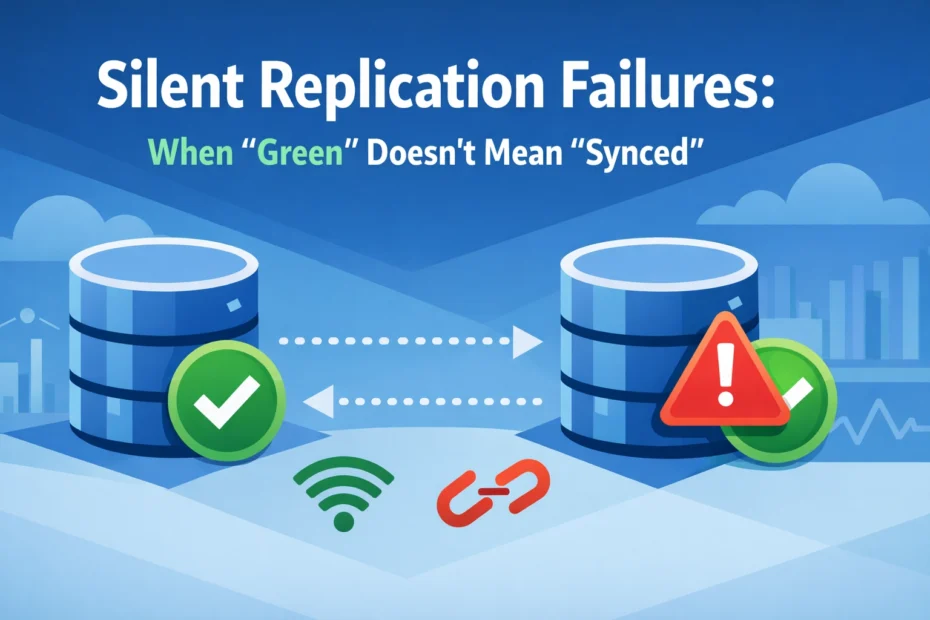
You check your Replication Monitor. Everything's green. The latency looks good, the transaction count is normal, and there's not a single error message in sight. You breathe easy, your disaster recovery site is perfectly in sync, right?
Wrong.
We've seen this scenario play out too many times over our 20+ years managing SQL Server environments. Your replication dashboard is lying to you, and you won't know it until something catastrophic happens, like a failover that lands you with completely different data than you expected.
What Exactly Is a Silent Replication Failure?
A silent replication failure is exactly what it sounds like, replication that appears to work perfectly while quietly failing to keep your data in sync. The Replication Monitor shows green checkmarks. The distribution agent reports success. Your alerts stay silent. But underneath that reassuring façade, your subscriber database is slowly drifting away from your publisher.
The data at your secondary site isn't what you think it is.
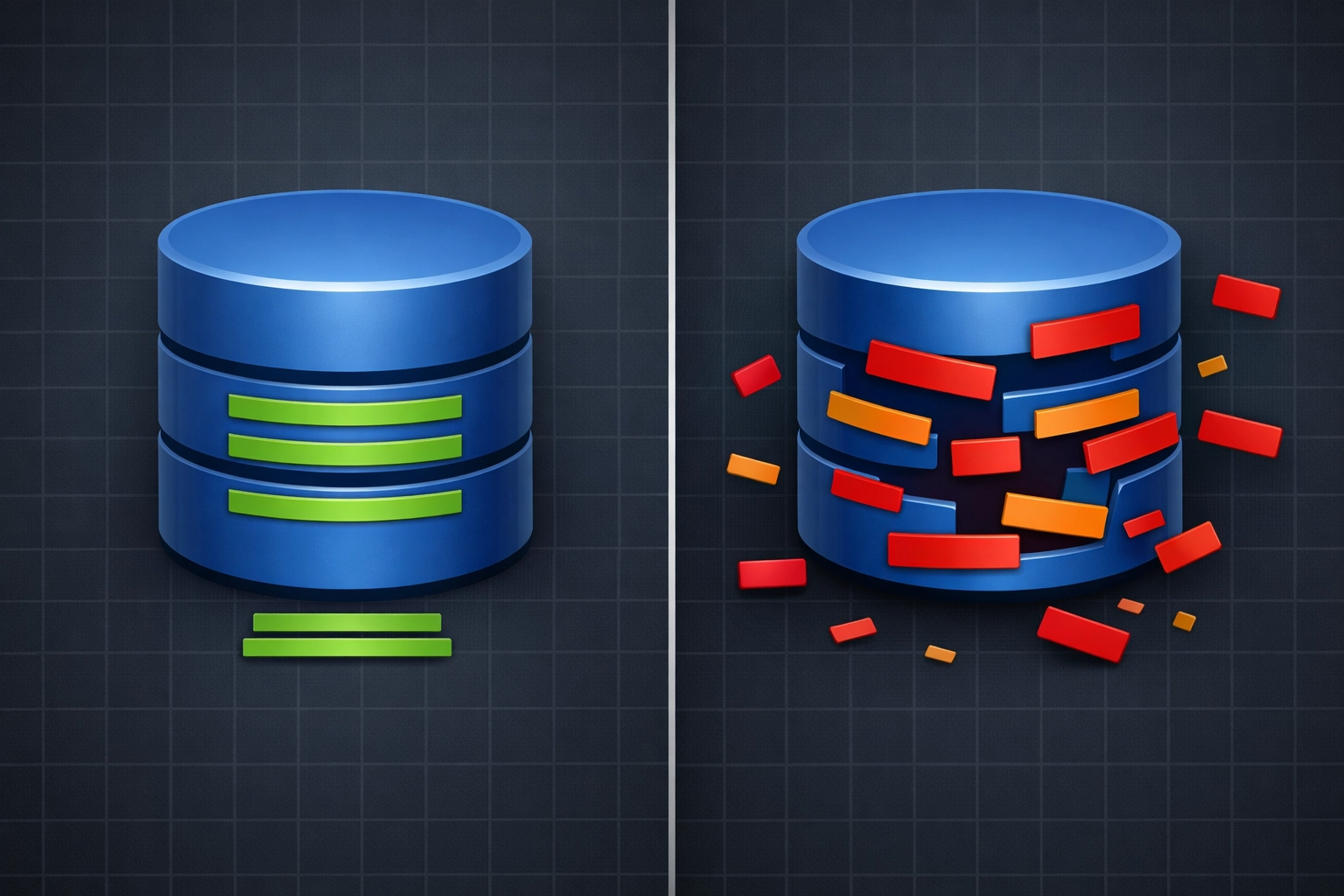
This isn't about replication breaking completely, that would actually be easier to spot. This is about replication continuing to run while silently dropping records, skipping updates, or applying changes incorrectly. The system reports "success" while data corruption accumulates like rust on a pipeline you can't see.
The Common Culprits Behind Silent Failures
Let's talk about what actually causes these hidden disasters. In our experience, silent replication failures typically stem from a handful of recurring issues.
Manual updates on the subscriber side are probably the biggest offender we see. Someone, maybe a developer testing a query, maybe a well-meaning DBA making a "quick fix", modifies data directly on the subscriber. Replication doesn't know about these changes. When the next legitimate update comes through from the publisher, you get a conflict. Sometimes that conflict logs an error. Sometimes it just silently fails and moves on.
Data corruption that hasn't triggered an alert yet is another sneaky problem. A few corrupted pages here and there might not bring your system down, but they can absolutely prevent replication from applying changes correctly. The distribution agent might skip over the bad rows and keep churning through the queue, reporting success while leaving gaps in your data.
Schema mismatches between publisher and subscriber may silently drop data all day long. Maybe someone added a new column on the publisher but forgot to update the subscriber schema. New rows come through with that extra column, replication tries to apply them, hits a constraint violation or missing column error, logs it quietly, and moves on. Your dashboard stays green.

The Danger: When Good Data Goes Bad
Here's where this gets scary. You're making business decisions based on reports generated from your subscriber database, thinking it's a perfect mirror of production. It's not. Your sales numbers are off. Your inventory counts are wrong. Your customer records are incomplete.
Or worse, you need to failover to your disaster recovery site after a catastrophic failure on your primary server. You flip the switch, confident that your DR site is current and ready. Then you discover that weeks or months of data are missing, corrupted, or just plain different.
We worked with a client last year who discovered their reporting subscriber was missing about 15% of their order records over a six-month period. The replication monitor looked perfect the entire time. They only found out when finance noticed the revenue numbers didn't match between systems during month-end close. The silent failures had been happening daily, accumulating into a massive data integrity nightmare.
Transaction conflicts accumulate over time. Each silent failure compounds the problem. Your data drifts further and further from reality while your monitoring tools tell you everything's fine.
Why Your Monitoring Isn't Catching This
Standard replication monitoring focuses on whether the agents are running and whether they're processing transactions. It doesn't validate that the actual data values match between publisher and subscriber.
Many systems lack robust error handling for individual row failures. An error gets logged to a table nobody checks regularly, and the replication task continues. There's no automatic escalation, no alert threshold that says "hey, you've had 50 errors in the last hour: something's wrong."
Network issues can cause silent data drops. A batch of transactions gets partially applied, but the monitoring system only sees that the batch finished: not that half the records failed.
And here's the kicker: row-by-row replication doesn't guarantee transactional consistency. Each row might succeed individually while the logical relationship between those rows breaks down. Your foreign keys might point to records that don't exist. Your aggregated totals might not add up. But each individual row replicated successfully, so the system reports green.
Detection Strategies That Actually Work
At Stedman Solutions, we've built detection mechanisms that go beyond just checking if the replication agent is running. Our Database Health Monitor actively validates data consistency at the byte level.
Checksum validation is one of our primary tools. We calculate checksums for tables on both the publisher and subscriber, comparing the actual data values: not just row counts. Two tables might have the same number of rows, but if the column values differ, the checksums won't match. That's your red flag.
We also monitor error rate patterns over time. A sudden spike in errors: even if they're not stopping replication: is an early warning sign. We escalate these patterns before they become catastrophic.
Transaction sequence validation helps us spot missing or out-of-order transactions. We track the logical flow of changes and flag any gaps or inconsistencies in the sequence.
And we perform periodic spot-checks on critical tables, comparing a sample of high-value records between publisher and subscriber. If we find discrepancies in the sample, we know to dig deeper.
How We Find What Your Monitoring Misses
Our team doesn't just rely on automated tools: we bring decades of hands-on SQL Server experience to every engagement. With 3+ US-based DBAs each carrying over 20 years of experience, we've seen every flavor of replication failure you can imagine (and plenty you probably can't).
We use our proprietary Database Health Monitor to continuously validate your replication health. It's not just watching for errors: it's actively comparing data, tracking patterns, and alerting on anomalies that standard monitoring ignores.
But more importantly, we provide expert validation. Our team reviews your replication topology, identifies weak points, and proactively tests failover scenarios. We don't wait for production to break: we find the issues during controlled audits.
Our Replication Health Audit Process
When we conduct a replication health audit, we're looking at the full picture:
- Topology validation: Is your replication architecture designed correctly for your workload?
- Data consistency checks: Do publisher and subscriber actually match at the data level?
- Error log analysis: What's being logged that nobody's looking at?
- Performance baseline: Is replication keeping up with your transaction volume?
- Failover testing: Will your DR site actually work when you need it?
We've saved clients from disaster more times than we can count by finding silent failures during routine audits. One client was about to go live with a major application relying on replicated data. Our audit found that 8% of their records weren't replicating due to a subtle schema mismatch. They would have gone into production with bad data if we hadn't caught it.
Don't Wait for the Disaster
Silent replication failures are insidious because you don't know you have a problem until you really, really need that data to be correct. By then, it's too late to prevent the damage: you're in recovery mode, trying to figure out what's missing and how to fix it.
If you're relying on replication for reporting, disaster recovery, or load distribution, you need more than a green dashboard. You need actual data validation and expert oversight.
Our SQL Server Managed Services include proactive replication monitoring and validation as part of comprehensive database health management. We watch your systems 24/7 with both automated tools and human expertise, catching issues before they impact your business.
Whether you need ongoing managed services or a one-time replication health audit, our team is ready to help. We offer a free 30-minute consultation to assess your current replication setup and identify potential risk areas.
Don't trust the green lights. Trust the data: and the experts who know how to validate it.
Contact us today for your free consultation and let's make sure your "synced" databases are actually in sync.